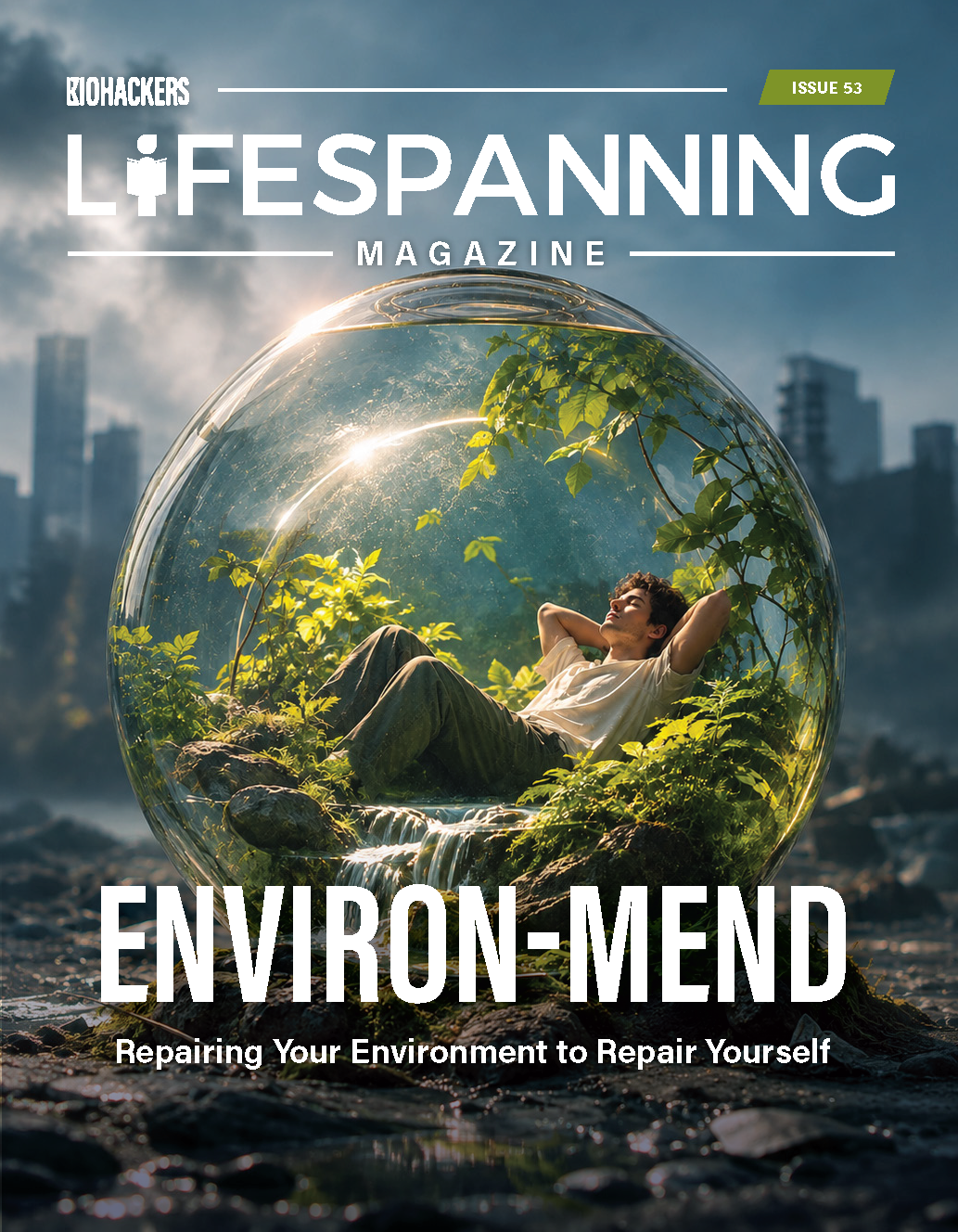
Lifespanning Magazine’s 53rd edition, Environ-Mend, explores a simple but often overlooked idea: we can’t fully repair ourselves without also tending to the environments we live in. Through expert perspectives and practical guidance, the issue examines drug-resistant pathogens and nano silver, the shock of “retoxing” after time away, the emotional and relational spaces that shape our stress biology, and Ayurveda’s view of aging as a process of drying out. It also explores frequency-based approaches to synthetic materials, and how red, blue, and purple states of mind shape the way we live. Together, these features ask readers to look beyond what they put into their bodies and consider what surrounds them, from the air, water, and materials of daily life to the relationships, rhythms, and inner dialogue that influence how we feel and age.
What You Will Learn?
Issue 53 of Lifespanning Magazine turns its attention outward, to the environments that shape our health every day. Moving beyond the idea that wellness is only about what we eat, take, or track, the edition explores how air, water, materials, light, noise, relationships, and daily rhythms may influence stress, recovery, aging, and longevity.
Keith Moeller, ND, opens the issue with a look at Candida auris, a drug-resistant fungus that health authorities report is spreading in healthcare settings across the U.S. and the world. Drawing on silver’s long history in medicine and on laboratory testing he has facilitated since 2019, he examines nano silver as a tool against drug-resistant microbes, including a recent FDA clearance for antimicrobial wound care.
Dr. Lauren Leiva introduces “RETOX,” her term for the jarring contrast many people feel when they come home after time away. Reflecting on a trip to Costa Rica and her return to Florida, she explores how easily we adapt to, and stop noticing, the conditions we live in. She encourages readers to approach their surroundings with curiosity rather than fear, and to advocate for healthier shared environments.
Dr. Lisa Piper extends the conversation beyond what sensors can measure. Her article looks at relationships, workloads, digital habits, emotional atmospheres, and inner dialogue as environmental inputs the nervous system is constantly processing. She explores how these inputs add to allostatic load and why our internal environment deserves the same attention we give the air and water around us.
Ayurvedic practitioner Nidhi Bhanshali Pandya shares an ancient perspective on aging summed up in one phrase: drying is dying. Through her Inner Climate® framework, she explains how stress, overstimulation, and modern surroundings can speed up depreciation. She also offers five practices for staying supple: oiling the body, protecting deep rest, slowing the breath, eating food that is alive, and rejuvenating with rasāyana.
Wendy Cohn-Osborne, co-founder of beeem it™, explores the tension between healthy intentions and a world full of plastics, polyester, and synthetic materials. She introduces beeem™’s light-based frequency approach to everyday belongings, from athletic wear to pet bedding, and presents early observations as a starting point for further investigation.
Finally, in conversation with Lifespanning, surgeon Dr. Arpit Bansal describes his red mind, blue mind, and purple mind framework for understanding stress, calm, and flow. He shares how water, running, and circadian rhythms reshaped his approach to medicine, and why healing must account for the room the body lives in.
Together, these stories invite readers to see environmental wellness not as an escape from modern life, but as the ongoing work of mending the spaces, inside and out, that shape who we become.